Project Overview†
The huge computing power of multi-processor systems would require very large on-chip and off-chip data transfer rates (> 100TB/s). One efficient technology for transmitting this level of information is the photonics interconnects, which promise significant advantages over their electronic counterparts. In particular, nanophotonics (light on the nanometer scale on nanometer-scale devices) on-chip interconnects offer a potentially disruptive technology solution with fundamentally low power dissipation, ultra-high bandwidth and low latency. In addition, when combined with 3D integration technology, photonics interconnect offers advantages over electronic 2D NoC design, such as shorter wire length, higher packing density, and smaller footprint. From another hand, to ensure that these complex systems are able to accommodate faults and maintain operation, there is a needs for the development of an efficient mechanisms that can self-detect, self-diagnosis and self-recover in the processing cores as well as in the on-chip interconnects (NoC). The goal of this project is to study new reliable optical interconnect solutions to improve energy efficiency and data bandwidth of on-chip interconnects for embedded and high-performance many-core systems.
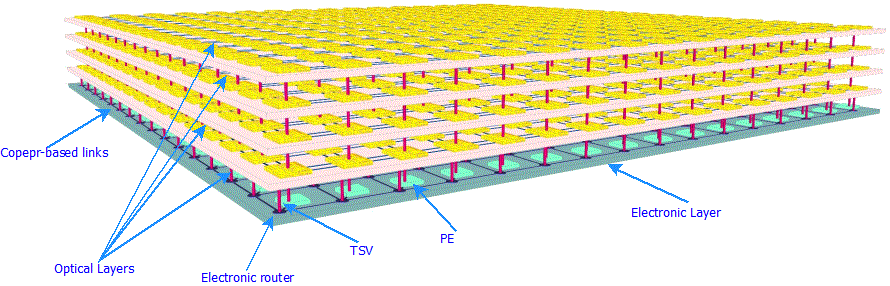
PHENIC Architecture
Members†
- D3 Achraf Ben Ahmed: Doctor Thesis Title: "High-performance, Scalable Photonics On-chip Network for Many-core Systems-on-Chip"
- D2 Michael Meyer: Reliable Photonics Netwok-on-Chip Architecture for Many-core Systems-on-Chip
Publications†
- 11 Achraf Ben Ahmed, Michael Meyer, Yuichi Okuyama, Abderazek Ben Abdallah, Hybrid Photonic NoC based on Non-blocking Photonic Switch and Light-weight Electronic Router, Proc. of the IEEE International Conference on Systems, Man, and Cybernetics (SMC2015), Oct. 9-12, 2015.
(PAPER)
- 10 Achraf Ben Ahmed, Yuichi Okuyama, Abderazek Ben Abdallah, Contention-free Routing for Hybrid Photonic Mesh-based Network-on-Chip Systems, Proc. of 9th IEEE International Symposium on Embedded Multicore/Many-core SoCs (MCSoC-15), Sept. 2015.
(PAPER)
- 9 Michael Meyer, Akram Ben Ahmed,Yuichi Okuyama, Abderazek Ben Abdallah, Microring Fault-resilient Optical Router for Reliable Network-on-Chip Systems, Proc. of 9th IEEE International Symposium on Embedded Multicore/Many-core SoCs (MCSoC-15), Sept. 2015.
(PAPER)
- 8 Michael Conrad Meyer, Akram Ben Ahmed, Yuki Tanaka, Abderazek Ben Abdallah, "On the Design of a Fault-tolerant Photonic Network-on-Chip", Proc. of the IEEE International Conference on Systems, Man, and Cybernetics (SMC2015), Oct. 9-12, 2015.
(PAPER)
- 7. A.Ben Ahmed , Y.Okuyama, A.Ben Abdallah, "Non-blocking Electro-optic Network-on-Chip Router for High-throughput and Low-power Many-core Systems", accepted for publication in The World Congress on Information Technology and Computer Applications 2015, Hammamet, Tunisia, June 11-13, 2015 (Latex), (PDF) , (Slides)
- 6. A.Ben Ahmed, M.Meyer, Y.Okuyama, A.Ben Abdallah, "Effi�cient Router Architecture, Design and Performance Exploration for Many-core Hybrid Photonic Network-on-Chip (2D-PHENIC)", accepted forpublication in the 2015 International Conference on Information Science and Control Engineering ICISCE 2015, Shanghai, China, April 24-26, 2015 (Latex) (PDF)
- 5. Achraf Ben Ahmed, A. Ben Abdallah, PHENIC: Towards Photonic 3D-Network-on-Chip Architecture for High-throughput Many-core Systems-on-Chip, IEEE Proceedings of the 14th International conference on Sciences and Techniques of Automatic control and computer engineering, Dec. 2013. DOI
- 4. Achraf Ben Ahmed, A. Ben Abdallah, Hardware/Software Prototyping of Dependable Real-Time System for Elderly Health Monitoring,
IEEE Proc. of the World Congress on Computer and IT, ICMAES, June 2013.
[DOI]
- 3. Achraf Ben Ahmed, Yumiko Kimezawa, A. Ben Abdallah, Towards Smart Health Monitoring System for Elderly People, IEEE Proceedings of The 4th International Conference on Awareness Science and Technology, pp. 248-253, 2012.
[DOI]
Theses†
- Achraf Ben Ahmed, High-performance Scalable Photonics On-chip Network for Many-core Systems-on-Chip, Ph.D. Thesis, Gradute School of Computer Science and Engineering, The University of Aizu, March 2016, Thesis.pdf, Slides.pdf
- Saito, Ken, Design and Analysis of Electrical Control Router for Hybrid Photonics NoC System, Bachelor Thesis, School of Computer Science and Engineering, The University of Aizu, March 2016.
- Okada, Ryoga, Power and Performance Comparison of Electronic 2D-NoC and Opto-Electronic 2D-NoC, Bachelor Thesis, School of Computer Science and Engineering, The University of Aizu, March 2016.
Techncial Reports†
- Achraf Ben Ahmed, PHENIC Design-Flow Poster, Technical Report, Adaptive Systems Laboratory, Division of Computer Engineering, School of Computer Science and Engineering, University of Aizu}, Janury 18, 2016.
Invited talks†
Tutorials†
Posters†
Links†
![[PukiWiki]](image/pukiwiki.png "[PukiWiki]")


